
Brand, comms and insights teams · 9 min read ·
How to track brand mentions on Twitch, YouTube and Kick
Live streaming is the blind spot in most listening stacks. What can be tracked in chat and descriptions, with a worked 30-day example: 94,208 mentions across 12,070 channels.
Most brands monitor Twitter, Reddit, Instagram and TikTok, and have no idea what happens to their name on live streaming. That is a large gap: one energy drink brand collected over 94,000 mentions across 12,000 channels in a single month, and almost none of it would appear in a conventional listening tool.
The blind spot in social listening
Conventional social listening works because posts persist. A tweet has a URL, a Reddit thread is indexed, an Instagram caption sits there to be crawled. Live streaming breaks all three assumptions. Chat is produced at a rate of thousands of messages an hour, it is not indexed, it is not searchable after the stream ends, and it lives behind platform APIs rather than on the open web.
So the largest concentration of real-time conversation about games, hardware, energy drinks, betting and software is invisible to the tools most brand teams pay for. It is not that streaming is unimportant to them — it is that nothing in the stack can see it.
What can actually be tracked
Two text surfaces, across three platforms, in real time:
- Live chat messages — what viewers type while a stream is running. High volume, unprompted, and the closest thing to overheard conversation a brand can measure.
- Channel descriptions — what streamers write about themselves and their streams, including affiliate links and sponsor credits. Lower volume, higher intent.
Scope is set per keyword, so you can monitor chat only, descriptions only, or both. Platforms covered are Twitch, Kick and YouTube Gaming. The tool doing this in the examples below is Brand Radar, built by Streams Charts — the same platform whose measurement data sits behind MIRAI campaign reporting.
Worth separating from a related thing: this is text. What a streamer says out loud is a different measurement problem, solved by running voice recognition over stream audio — which is part of how a campaign is measured rather than something you point at the whole platform.
A worked example: Red Bull, 30 days
Tracking #RedBull and the alias Red Bull across all three platforms, 10 August to 7 September 2026:
94,208
Total mentions
30 days
12,070
Unique channels
distinct streamers
+2%
vs previous 30 days
6,913
Peak day
22 Aug 2026
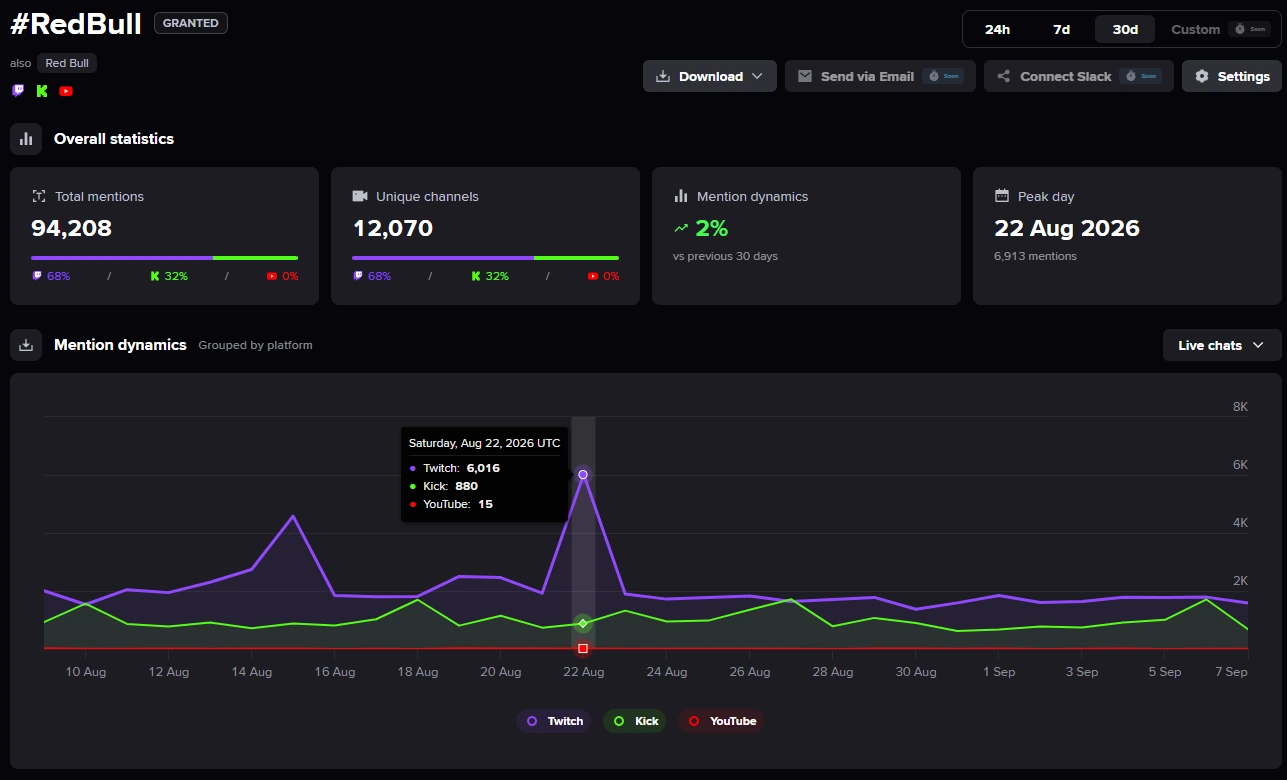
#RedBull and the alias Red Bull across Twitch, Kick and YouTube Gaming, 10 August to 7 September 2026. The daily series shows the shape that matters — a stable Twitch and Kick baseline with one sharp spike on 22 August. View full sizeTwo things in that are worth stopping on. The first is the platform split.
- Twitch
- 68%
- Kick
- 32%
- YouTube Gaming
- 0%
Kick carries 32% of the conversation about a brand most people would place squarely on Twitch, and YouTube Gaming rounds to zero. A media plan built on the assumption that streaming means Twitch is leaving roughly a third of the existing conversation unattended — and paying Twitch rates for the part it does attend. The YouTube figure is a reminder that its live chat culture is much thinner than its video reach suggests, and that the two should never be planned as one channel. See choosing a platform.
The second is the ratio: 94,208 mentions across 12,070 channels — under eight mentions per channel. This is not a handful of large streamers repeating a sponsor line. It is a very wide, very shallow spread of ordinary chat across twelve thousand communities, which is what organic brand presence actually looks like and what no single sponsorship can manufacture.
The peak day is the third useful signal. 22 August drew 6,913 mentions against a baseline near 2,000 — Twitch 6,016, Kick 880, YouTube 15. A spike shaped like that is an event, and knowing which event caused it is the difference between a report and an insight.
Reading the audience splits
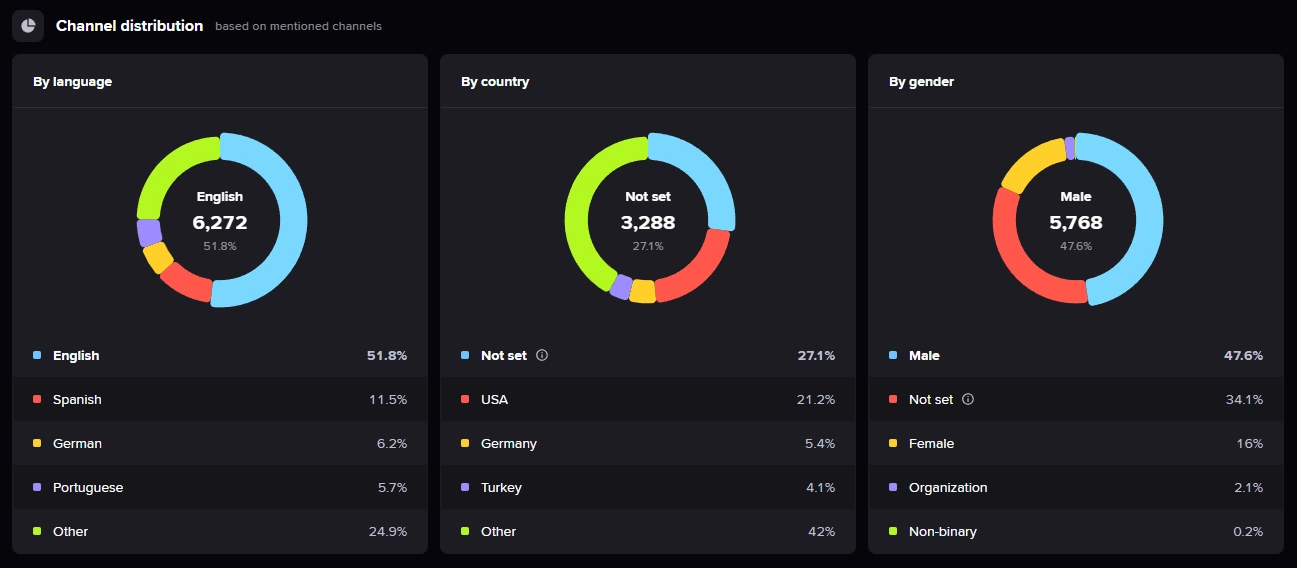
Because mentions are attributed to channels, the channels carry metadata. That turns a mention count into a rough audience profile.
- English
- 51.8%6,272
- Spanish
- 11.5%
- German
- 6.2%
- Portuguese
- 5.7%
- Other
- 24.9%
The language split is the most actionable of the three: English at 51.8% means nearly half the conversation is not in English, with Spanish, German and Portuguese together accounting for almost a quarter. For a brand running English-only creative, that is a localisation brief written by the data.
Be honest about the other two. On country, the largest single segment is “not set” at 27.1%, ahead of the USA at 21.2%, with Germany at 5.4% and Turkey at 4.1%. On gender, male is 47.6% and female 16% — but 34.1% is unset. Channel metadata is self-reported and frequently blank, which is why those two charts have a grey wedge larger than most of their real categories.
That does not make them useless. The shape of the known portion is still informative, and 21.2% USA against 5.4% Germany is a real difference. It does mean reading them as directional, quoting them with the unset share attached, and never presenting them as a complete demographic profile. Anyone showing you a chart like this without the unset column is hiding a third of the sample.
Five things to do with it
Mention volume on its own is a vanity metric. These are the questions it answers that a brand actually acts on:
1Verifying a campaign actually ran
A mention count that steps up on the days your creators streamed is proof the brief was followed.
- What to look at
- Daily dynamics against your campaign calendar, and unique channels against your contracted roster. A flat line on a paid day is a conversation to have.
2Share of voice against competitors
Track your brand and two rivals as separate keywords and compare the same 30 days.
- What to look at
- Relative totals matter more than absolute ones. A rival at three times your mentions in the same category is a budget argument with a number attached.
3Finding creators who already talk about you
Unique channels is a prospect list. Someone mentioning your product unpaid is the cheapest creator you will ever brief.
- What to look at
- The mention feed with context, filtered to channels you have never paid. Organic advocates convert better and negotiate more cheaply than cold outreach.
4Catching a problem while it is still small
An unexplained spike is either something very good or something very bad, and you want to know which within hours rather than days.
- What to look at
- Alerts on volume rather than a weekly report. Chat sentiment moves faster than anything a brand team normally monitors.
5Sizing a market before entering it
The language and country split tells you where a brand is already discussed before a single dollar is committed.
- What to look at
- Compare your keyword's regional mix against your current media plan. Mentions concentrated in a region you do not advertise in is a demand signal.
Setting it up
The setup that gets used is smaller than the one people plan. Brand Radar gives you one keyword free indefinitely, so start with the one that answers a question you already have. Three keywords is usually enough to run properly:
- Your brand, with its aliases. Track the hashtag and the plain form together — Red Bull above runs
#RedBullandRed Bullas one keyword, because chat writes it both ways. - One competitor. A single rival gives you a denominator, which is what makes your own number mean anything.
- Your current campaign. A campaign hashtag or product name, scoped to the campaign window, so verification is a chart rather than an argument.
Set alerts on volume rather than reading a weekly digest — the value of real-time detection is entirely in catching the spike while it is still happening. Then export monthly and keep the history, because the first comparison worth anything is against your own previous period.
Where to go next
Mention tracking tells you where the conversation already is. Turning that into a campaign is the rest of this section: the two ways to buy, where a brand can appear, and what it costs.
Questions this raises
- Can you track brand mentions on Twitch?
- Yes. Mentions in live chat and in channel descriptions can be tracked across Twitch, Kick and YouTube Gaming, in real time, with a count of total mentions, how many distinct channels mentioned the keyword, and how that volume moves day to day.
- What exactly gets tracked — chat, or what the streamer says?
- Text: live chat messages and channel descriptions, with the scope selectable per keyword. Spoken mentions are a separate problem, solved with voice recognition on the stream audio, which MIRAI applies to campaigns it runs rather than to open keyword monitoring.
- Why do social listening tools miss live streaming?
- Because the conversation is ephemeral and high-volume. A stream chat produces thousands of messages that are never indexed, never searchable afterwards, and sit behind platform APIs rather than on the open web — so tools built for Twitter, Reddit and Instagram never see them.
- How many mentions is a lot?
- Judge it relatively, not absolutely. Red Bull drew 94,208 mentions across 12,070 channels in 30 days; a mid-size gaming peripheral brand will sit orders of magnitude lower. The useful comparisons are against your own previous period and against named competitors.
- Does it cost anything to start?
- One keyword is free indefinitely across all three platforms, including the full mention feed, the language, country and gender breakdowns, CSV export and alerts. Additional keywords are $10 per keyword per month.